Services

AI that gets implemented.

Five service lines, one order of operations. We educate your team, structure the plan, build the systems and stay to maintain them. Each line below says what it is, what you receive, who it suits, when firms ask for it and how long it takes.

01 · The usual starting point

The Audit

Where AI fits in your practice.
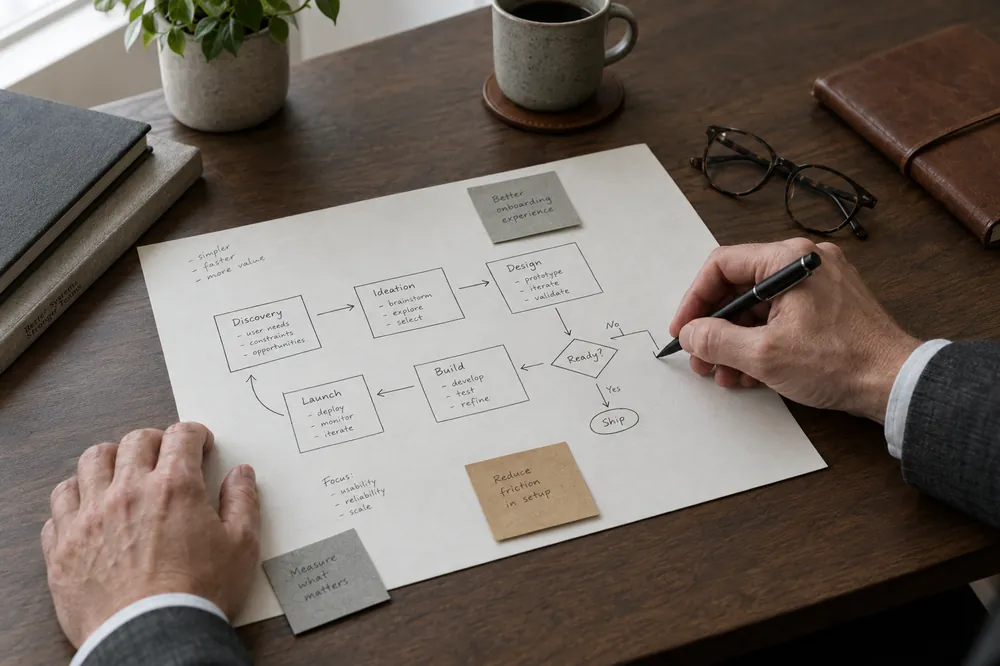
Hands marking a printed process map with a pen on a walnut desk

A structured review of how work actually moves through your firm — the tools, the data, the hand-offs between people — to find where AI delivers a measurable return first.

We sit with the people who do the work, not just the people who manage it. We map each recurring task, note where time is lost or errors creep in, and score every candidate for effort, risk and expected payback. The Audit also settles the platform question (what to use, what to avoid, what your regulator and your clients would expect) and ends in a sequenced plan with budget, so you can execute it with us or on your own.

What you receive

  • A prioritised opportunity map with effort, risk and expected payback for each candidate
  • Platform and tool recommendations, vendor-neutral
  • Privacy and compliance considerations, written for your regulator
  • A sequenced implementation roadmap and budget

Who it suits

Any firm that has heard it should adopt AI and wants a clear, honest answer about where — before spending on tools. It is the starting point for almost every engagement, and it stands alone if you decide to build in-house.

Typical situations

Partners disagree about where to start. A tool was bought and sits unused. A vendor is proposing a platform and nobody can judge the proposal. Growth has outrun the admin team.

Format and timing

Two to three weeks. Interviews with the people who do the work, the Audit Workbook completed with you, placement on the Readiness Model, and a written plan presented to the partners. Fixed fee, quoted after the first call.


02 · Build

The Front Desk

Intake, scheduling, follow-up.

The empty reception desk of a small professional practice in morning light

The first hour of every client relationship, handled consistently: enquiries answered, meetings booked, information gathered and follow-up drafted for your approval.

Most firms lose new business in the gap between an enquiry and a reply. The Front Desk closes that gap with an assistant trained on your services and your tone, an intake flow that asks the right questions in the right order, and follow-up that is written, queued and waiting for a human to approve. Your team stays in control of every message that leaves the firm.

What you receive

  • A client-facing assistant trained on your firm's services, standards and voice
  • Intake and scheduling flows connected to your calendar and CRM
  • Follow-up drafted automatically and routed for approval
  • Documentation and a handover session for the people who run the desk

Who it suits

Advisors, brokers, law and accounting practices, clinics and any client-facing firm where response time decides whether a prospect becomes a client.

Typical situations

Enquiries wait until someone is free. Prospects book elsewhere in the gap. The first meeting starts from scratch because nothing was gathered beforehand. Follow-up depends on memory.

Format and timing

Four to eight weeks for a first workflow, built on your calendar, inbox and CRM. Agent roles from the library: Intake, Briefing and Follow-up, each with its approval point written into the Operating Standard.

03 · Build

The Back Office

Documents, data, compliance workflow.

Shelves of client binders in a back office with a closed laptop on an oak table

The work nobody sees and everybody depends on: meeting documentation, file notes, standard documents, data moving between systems, and the recurring operations that keep a practice compliant.

This is where agentic AI earns its place. Agentic AI, as we use the term: AI that completes multi-step work — gathering, drafting, updating and routing — with your team reviewing and approving. A meeting ends and the notes, the action items and the CRM update are done. A document request arrives and the draft is waiting, built to your template, with the review step clearly marked. Every workflow is designed around your privacy and compliance obligations first.

What you receive

  • Meeting-to-CRM automation with notes, tasks and follow-ups
  • Document automation built on your templates and standards
  • Agentic workflows for recurring operations, with approval steps
  • A research system that gathers sources, checks them and returns a cited brief for review
  • Integrations between the systems you already pay for
  • Working systems in production, documented and handed over

Who it suits

Regulated and compliance-heavy firms — financial advisors and planners, accountants, lawyers, mortgage brokers, insurance advisors — and any owner-led business carrying a heavy documentation load.

Typical situations

Meeting notes are written up days later, or not at all. Standard documents are rebuilt from the last one each time. Compliance tasks live in someone’s head. Research is a browser tab and a hope.

Format and timing

Four to eight weeks per workflow, sequenced from The Audit. Agent roles: Meeting to record, Document drafting, Research, Renewal and recall, Standards check and, for recurring operations, Coordinator.

04 · Build

The Studio

Content and client communication.

Printed newsletter proofs, headphones and a microphone on a dark table

Client letters, newsletters, market notes, articles and social posts produced on one consistent system, in your voice, with review and compliance sign-off built into the process.

Most firms know they should communicate more and do not, because every piece starts from a blank page. The Studio replaces the blank page with a system: a voice guide, a set of formats, a research step that pulls from sources you trust, and a drafting workflow that leaves your team editing rather than writing. Where a compliance review is required, it is a step in the flow, not an afterthought.

What you receive

  • A written voice and format guide for the firm
  • Content workflows for the channels you actually use
  • Review and compliance steps where your regulator requires them
  • A content calendar your team can run without us

Who it suits

Firms that win business on trust and expertise and want a steady, credible presence without hiring a marketing department.

Typical situations

The newsletter went out twice and stopped. Social posts depend on one person’s mood. Market notes are written at eleven at night. Compliance review happens after publishing, if at all.

Format and timing

Four to six weeks to a running system: a voice guide, formats for the channels you use, the Content agent role with its research and compliance steps, and a calendar the team can keep without us.

05 · Maintain

Staying with you

Training, standards, ongoing advisory.

Three colleagues at a boardroom table reviewing a printed document

Systems only hold if the people using them were taught properly and someone is accountable for keeping them current. This is the education and maintenance half of the work.

Training is hands-on and specific to your firm: your tools, your files, your rules. It produces a written operating standard that says how AI is used, what it may touch, what it may never touch, and who approves what. Ongoing advisory is fractional AI leadership on retainer: a quarterly review of what is working, new capability introduced when it is ready, governance and vendor evaluation as the landscape shifts. You get a standing partner accountable for the firm's AI function without adding a hire.

What you receive

  • Team training sessions, hands-on and role-specific
  • A written operating standard for AI use in the firm
  • Quarterly optimisation and capability reviews
  • Governance, vendor evaluation and a named point of accountability

Who it suits

Firms that have built, or are about to build, and want the systems to still be working a year from now. Training can also be booked on its own for teams that simply want to understand agentic AI before deciding anything.

Typical situations

Something was built and use is fading. Staff have changed and the new people were never trained. A regulator has published guidance and nobody has checked the standard against it. The tools have moved on.

Format and timing

A monthly retainer with the Quarterly Review at its centre, retraining as the team changes, the Operating Standard revised as rules and tools move, and a named person accountable for the firm’s AI function. See Training for formats that can be booked alone.

What we build

Agent roles from the library, each with a person in the loop.

The build lines draw on a library of ten agent roles built for professional practices. Most engagements configure two or three first, chosen in The Audit. Every one runs inside tools you already pay for, drafts to a standard you wrote down, and stops for approval before anything reaches a client or a record.

  • 01

    Intake and Briefing

    The enquiry answered and qualified, the meeting booked, and a one-page brief ready before the conversation starts.

  • 02

    Meeting to record and Follow-up

    A finished meeting becomes notes, tasks, the CRM update and follow-up drafts, queued for approval.

  • 03

    Research

    A question becomes a cited brief with disagreements and open questions marked, checked by a person before it is relied on. Market, regulatory, due-diligence or client-specific.

  • 04

    Document drafting and Standards check

    Standard documents drafted to your templates, then read against the Operating Standard before they reach the approver.

  • 05

    Renewal and recall

    Date-driven outreach that runs on the calendar, not on memory, approved in batches.

  • 06

    Content and Coordinator

    Client communication on one voice with compliance built in, and the role that sequences the others for a recurring operation.

How an engagement works

Educate. Structure. Build. Maintain.

The same four phases in every engagement, whichever service lines are involved. Inside them, each workflow moves through the five-step method: Map, Weigh, Redesign, Govern, Prove. Outcomes are defined in hours, dollars or output before work begins and measured against that definition. No guaranteed results and no invented statistics.

  1. 01 · EDUCATE

    Educate

    Your team learns what agentic AI is, what it is not, and where it belongs in your firm.

  2. 02 · STRUCTURE

    Structure

    The Audit: map the work, choose the tools, settle the rules, sequence the plan.

  3. 03 · BUILD

    Build

    The Front Desk, The Back Office, The Studio: working systems in production, documented and handed over.

  4. 04 · MAINTAIN

    Maintain

    Staying with you: training, a written standard and a quarterly review.

Book a call

Not sure which line applies to your firm? That is what the first call is for.