
One workflow at a time, with a person in charge.
Firms do not need more AI ideas. They need a way to change one piece of work so the routine part runs on its own, the rules are written down, and the result is measured. That is the method, and every engagement runs on it.
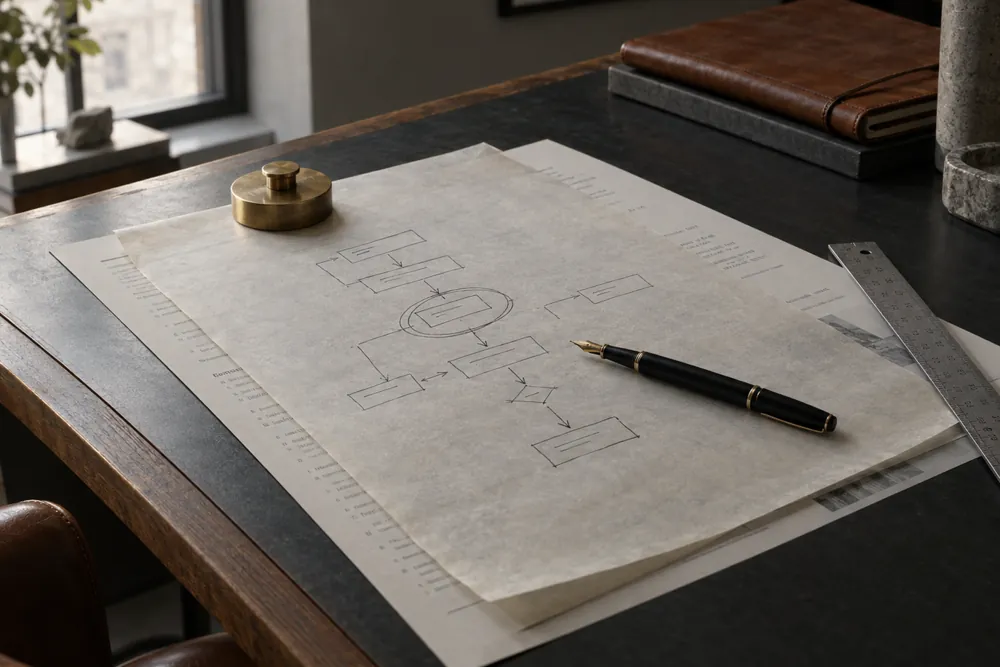
The gap between a pilot and a changed practice is a workflow question.
Most firms that call us have already tried something. A subscription, a pilot, an assistant someone built on a weekend. What they have not done is decide which piece of work should change, map how it really runs, and write down who is responsible once a system is doing part of it.
Automation runs the old process faster. Redesign asks what the process should look like if it were built today, with AI carrying the routine steps and a person deciding the ones that matter. The difference shows up in whether anything is still running a year later.
So we work on one workflow at a time, in five steps, and we do not skip the two that most projects skip: the rules and the measurement.
Map. Weigh. Redesign. Govern. Prove.
Each step produces something you can hold. Each one depends on the step before it, which is why the order does not change.
- 01
Map
How the work runs todayWe sit with the people who do the work and draw it: tasks, hand-offs, decisions, owners, where files wait and where errors appear. Assumptions are replaced with a picture everyone agrees is true.
- 02
Weigh
What the firm needs to gainThe outcome is defined in hours, dollars or output before anything is built. Each candidate is scored for effort, risk and expected payback, and the ones that fail the “so what” test are set aside in writing.
- 03
Redesign
AI as a working participantThe workflow is rebuilt from a blank page. Which steps a system gathers, drafts, updates or routes; which steps a person decides; what each hand-off looks like; what the system is given and what it returns.
- 04
Govern
The rules, written downWho approves what. What the system may touch and may never touch. What happens when it is uncertain or wrong. How much autonomy it starts with and what has to be true before that grows. This becomes the firm’s Operating Standard.
- 05
Prove
Measured against the baselineThe new workflow is measured against the numbers from Map and Weigh on a fixed cadence. It is kept, adjusted or retired on the evidence, and the next workflow is chosen the same way.
More than a prototype.
A single cycle leaves the firm with a working system and the paperwork that lets it keep working without us.
- A documented picture of how the workflow runs today, agreed by the people who run it.
- A written outcome in hours, dollars or output, with the baseline it will be measured against.
- A redesigned workflow with defined system roles, human roles and hand-offs.
- The Operating Standard for that workflow: approvals, limits, escalation, retention and client disclosure.
- The system itself, running inside tools you already pay for, documented and handed over.
- A measurement sheet and a quarterly review date.
Inside a four-phase engagement.
Educate, structure, build, maintain is the shape of an engagement. The five steps are what happens to each workflow inside it.
- 01 · EDUCATE
Educate
Partners and staff learn what agentic AI is and is not, and what the five steps will ask of them. See Training.
- 02 · STRUCTURE
Structure
Map and Weigh, across every candidate workflow in the firm. This is The Audit, and it ends in a sequenced plan.
- 03 · BUILD
Build
Redesign and Govern, one workflow at a time, through The Front Desk, The Back Office or The Studio.
- 04 · MAINTAIN
Maintain
Prove, on a quarterly cadence, with training and the Operating Standard kept current. This is Staying with you.

Five stages. Most firms call us from the second.
Before The Audit begins we place the firm on this ladder, and we place it again at every quarterly review. It keeps the conversation honest: a firm at stage two does not need an agent platform, it needs a standard and one redesigned workflow.
The stages describe how a firm uses AI, not how much it spends. A two-person practice can sit at stage four. A fifty-person firm with a licence for everyone can sit at stage two.
- 1
Curious
Heard about it, tried little
What it looks likeA tool may have been bought. Nobody uses it consistently. Client data policy is unwritten, so the default is either “never” or “whatever people do on their phones”.
What moves you upA briefing for the partners and a short written rule on what may and may never go into an AI tool.
- 2
Individual
A few people, their own way
What it looks likeTwo or three people use assistants for drafting and summarising. Results depend on who did it. There is no shared standard, no record of what was used, and no measurement.
What moves you upThe Audit: map the work, pick one workflow, write the Operating Standard, train everyone on the same tools the same way.
- 3
Standardised
Same tools, same rules
What it looks likeApproved tools, a governed workspace, a written standard and a trained team. AI assists with work; people still start and finish every task.
What moves you upRedesign a first workflow so the system does the gathering, drafting and routing and a person approves.
- 4
Systemised
Workflows run with approval steps
What it looks likeMeeting-to-record, intake, document drafting or research run as systems inside the firm’s tools. Each stops for a person at the points the standard requires. Results are measured.
What moves you upEvidence from Prove that lets specific steps run without a stop, and a second and third workflow built the same way.
- 5
Operated
Recurring operations end to end
What it looks likeAgentic workflows carry recurring operations from start to finish under the standard, with exceptions escalated to a person and a quarterly review of what runs and how well.
What keeps you hereStaying with you: the quarterly review, retraining as the team changes, and the standard revised as regulators and tools move.
From the first call to a working system.
Timelines vary with the firm and the workflow. This is the shape most first engagements take, so you know what you are agreeing to.
- WEEK 1
The call and the briefing
Thirty minutes to understand the firm. If it makes sense, a partner briefing and a written quote for The Audit.
- WEEKS 2 – 4
The Audit
Map and Weigh across the firm. Placement on the Readiness Model. A sequenced plan with budget, and a first workflow chosen.
- WEEKS 5 – 10
The first workflow
Redesign and Govern. The system is built inside your tools, the Operating Standard is written, the team is trained on it.
- WEEKS 11 – 13
Handover and baseline
Documentation handed over, measurement sheet started, the first quarterly review booked. The second workflow is chosen from the plan.
About the method.
How is this different from buying Copilot or ChatGPT for the team?
A licence gives every person a tool. The method changes a specific piece of work so the tool carries the routine part of it under written rules. Firms that only buy licences tend to end up at stage two of the Readiness Model: individual use, no standard, uneven results.
How long does one cycle take?
Map and Weigh take place inside The Audit, typically two to three weeks. Redesign and Govern take place in the build, typically four to eight weeks for a first workflow. Prove runs on a quarterly cadence after that.
Who in the firm needs to be involved?
The owner or a partner for decisions, and the people who actually do the work for the mapping. Two to four hours of their time across the first three weeks is usual. No technical staff are required.
What if the workflow turns out not to be worth redesigning?
Then Weigh says so and we move to the next candidate or stop. A documented decision not to build is a legitimate outcome of The Audit, and it is written up the same way.